








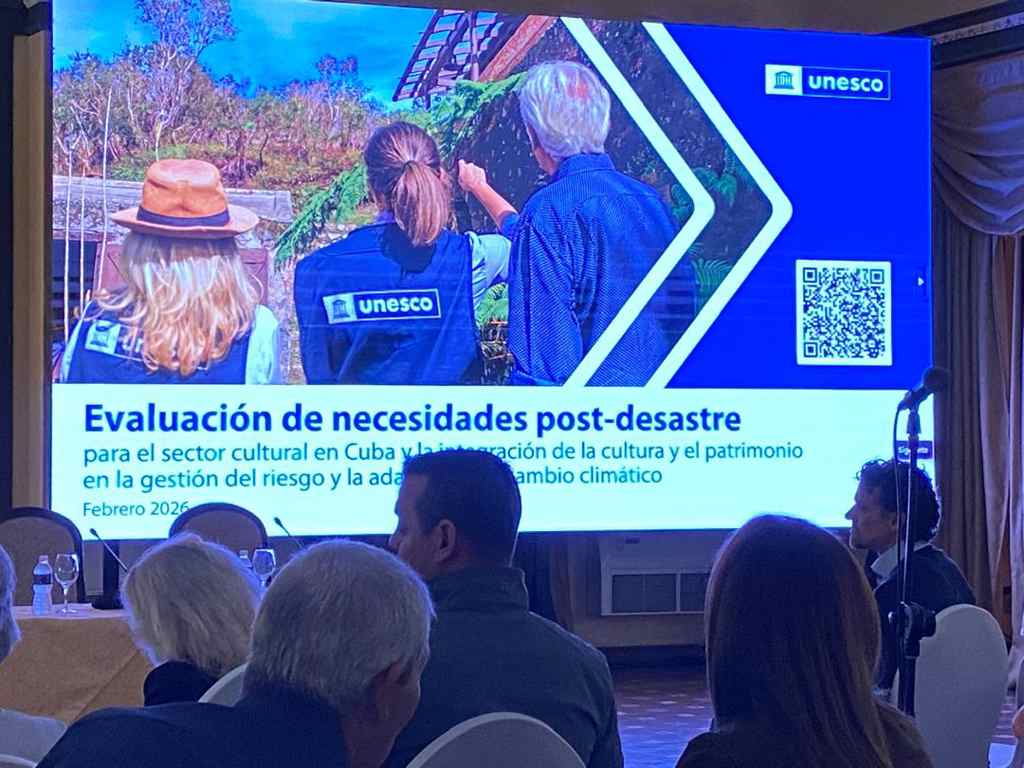
The Regional Office of the United Nations Educational, Scientific and Cultural Organization (UNESCO) presented the results of the report “Post-Disaster Needs Assessment for the Cultural Sector in Cuba and the Integration of Culture and Heritage in Risk Management and Adaptation to Climate Change,” during a meeting at the Hotel Nacional de Cuba in Havana.
The document was prepared after Cuba faced an unprecedented series of threats between October 2024 and October 2025.
The first was Hurricane Oscar in eastern Cuba, followed by Hurricane Rafael some weeks later, causing extensive damage in the western region, and later two 6.0 and 6.7-magnitude earthquakes that affected the Granma and Santiago de Cuba provinces.
A year later, on October 29, 2025, Hurricane Melissa, one of the most intense cyclones recorded in the Atlantic basin, severely hit the provinces of Santiago de Cuba, Granma, Holguin, and Guantanamo, which had already been affected by previous events.
Due to this series of hurricanes and earthquakes, the Cuban cultural sector suffered substantial direct and indirect damage.
The UNESCO report offers a strategic vision on the resilience of cultural institutions and proposes key actions to safeguard heritage in the face of the challenges of climate change and recent natural disasters.
Anne Lemaistre, director of the UNESCO Regional Office in this capital, highlighted, before concluding the event, the synergy achieved with national counterparts for gathering the necessary information and thanked the participants for their practical suggestions.
jdt/iff/otf/mml