








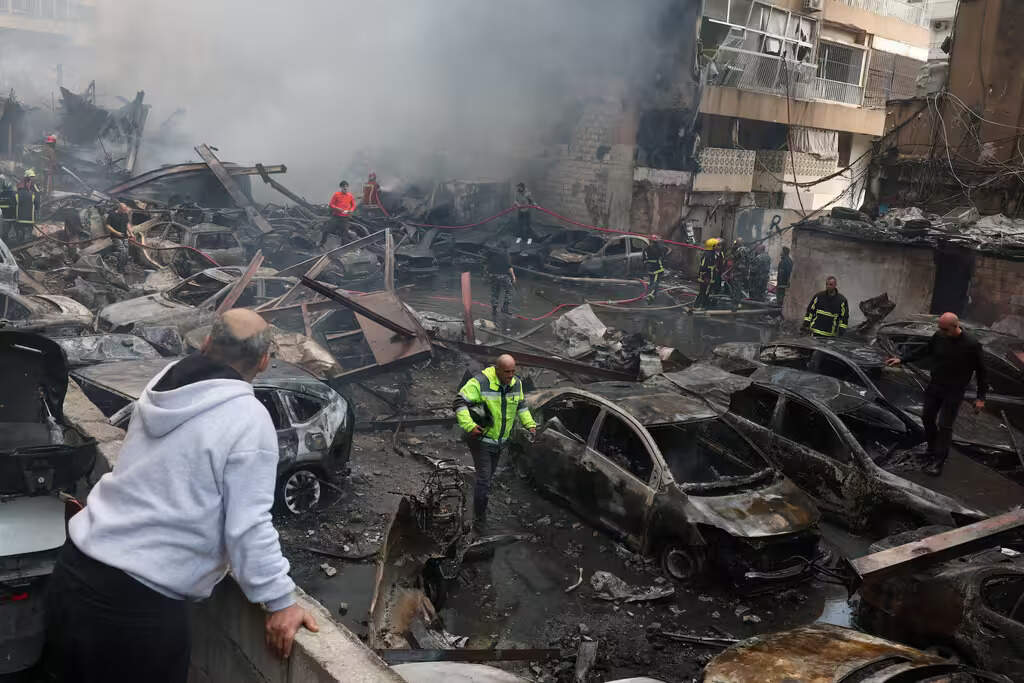
The offensive caused widespread destruction, particularly in the southern city of Nabatieh, the target of intense bombing considered among the most violent since the start of the large-scale aggression on March 2.
According to official reports, Israeli warplanes attacked government buildings, security facilities, and civilian structures in Nabatieh, killing 13 members of the State Security forces when their headquarters was hit.
Six people were killed in a bombing of a business in the town of Jbaa, while fatalities were reported in Deir Qanoun, Ras al-Ain, Sahmar, Qana, Hanawiya, Sharqiya, and Ansar, among other places.
In the east of the country, Israeli aircraft attacked areas of the Western Bekaa Valley and the Baalbek district, while artillery shelled multiple towns in the south, including Mansouri, Ain Baal, Sarbin, Beit Leef, Qleileh, and Ibl al-Saqi.
The attacks also left people wounded in various areas, including civilians near the border, and damaged ambulances, rescue equipment, and fire trucks, hampering emergency efforts.
According to Lebanese authorities, the offensive destroyed dozens of homes, businesses, and infrastructure along several kilometers, particularly on the Nabatieh-Haboush-Deir Zahrani highway.
Despite the announcement of a two-week ceasefire between the United States and Iran, with Pakistani mediation, Washington and Tel Aviv denied that the agreement includes Lebanon, while Tehran and Islamabad maintain the opposite.
jdt/mem/fm