








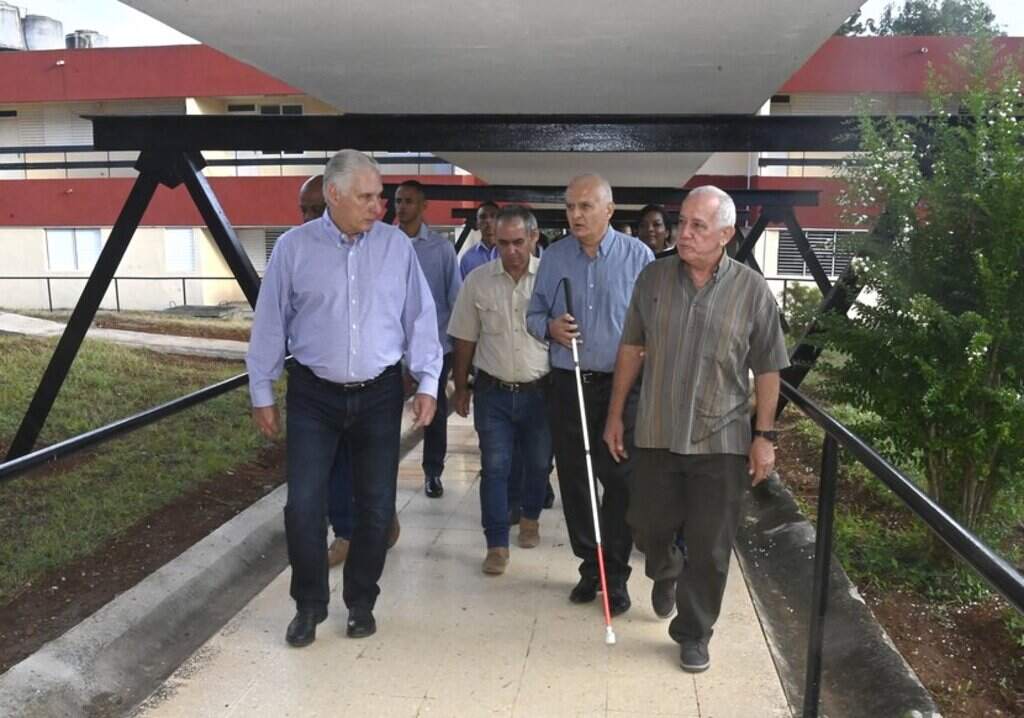
In the center’s guestbook, Diaz-Canel noted that the institution was born from Fidel Castro’s humanistic vision, affirming that its reopening serves as a proof to commitment, continuity, and the defense of social justice.
The president remarked that the initiative has been sustained by principles such as political will and solidarity—hallmarks of the Cuban revolutionary process.
The facility has resumed operations following a structural renovation. In this initial phase, it will focus on training specialized instructors who will extend visual rehabilitation programs to communities across the country.
During the event, Jorge Luis Cala, president of the National Association of the Blind (ANCI), stated that the center will continue to develop programs to foster the social inclusion of individuals with visual impairments, and announced new projects aimed at supporting people who are deafblind.
Meanwhile, Minister of Labor and Social Security Jesus Otamendiz reaffirmed the Cuban State’s commitment to strengthening inclusion policies and highlighted the role of special education within the nation’s educational system.
He also denounced the limitations imposed by the economic, commercial, and financial blockade—enforced by the United States—which hinders the acquisition of technologies, equipment, and supplies intended for people with disabilities.
jdt/las/mks
