








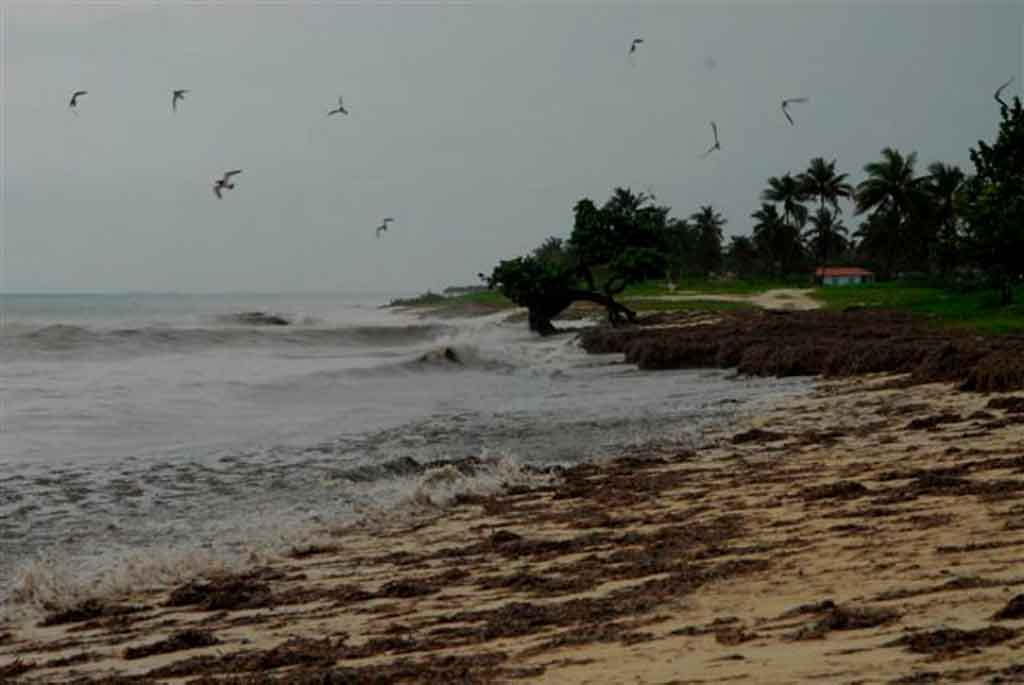
In this context, the Camagüey Environmental Research Center (CIMAC) developed a project aimed at strengthening the response capacity of coastal settlements to climate risks, with actions in La Gloria-Piloto, belonging to the municipality of Sierra de Cubitas, and Santa Rita, in Nuevitas.
According to data provided by the Final Report of the project “Community management model for sustainable development oriented towards disaster risk reduction and adaptation to climate change in coastal communities La Gloria-Piloto and Santa Rita”.
Among the main threats identified include sea-level rise, erosion, coastal flooding and salt wedge penetration, which can affect soils, groundwater, ecosystems and economic activities in these territories. The document, dated in November 2026, specifies that at La Gloria-Piloto a study of danger, vulnerability and risk to floods by heavy rains was completed, enriched with the analysis of coastal flood hazard. The latter contemplated scenarios associated with category one, three and five hurricanes.
As part of the results, climate change adaptation plans were also developed for the two communities, based on the assessment of their physical-natural, economic-productive and socio-demographic conditions, as well as the elements presented, existing vulnerabilities and local response capabilities.
One of the scientific contributions highlighted in the report was the incorporation of a new dimension, called climate risks, into integrated community diagnosis.
The analysis made it possible to identify present and future hazards, exposed elements, associated vulnerabilities and the response capacity of each settlement. According to the document, this experience was a novelty in the country and in the province.
The project involved 14 provincial and municipal institutions and 53 specialists.
It also identified 12 community initiatives to boost knowledge management and innovation, of which three were designed and implemented.
abo/mem/fam