








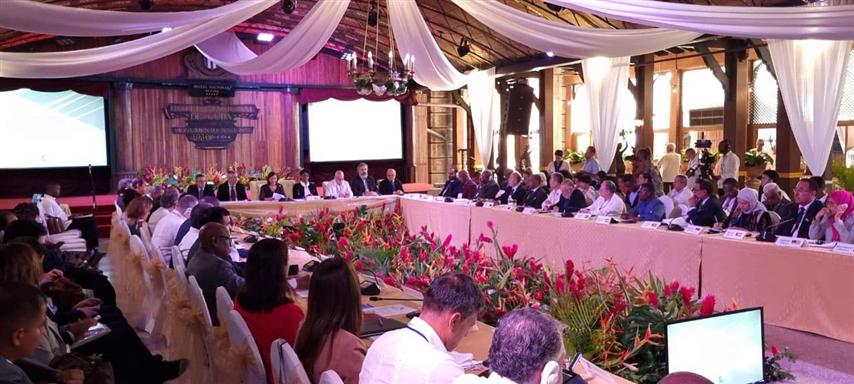
The complaint was made by the sectorial vice president of Science, Technology, Education, Gabriela Jiménez-Ramírez, in the context of the XIV International Convention on Environment and Development that culminates today in the Cuban capital.
Such punitive measures limit access to technology, prevent the creation of new capacities in education from research centers, and hinder the acquisition of equipment, reagents, and supplies that allow infrastructure to be modernized to address the challenges of climate change.
Jiménez-Ramírez called to think about science in a different way and break with the classic paradigms of capitalism, which today do more damage to the planet and to the human species.
Placing man and nature in the center of attention is responding rationally, while putting new methodologies based on research, experiences and innovation into practice, she said.
The challenge must be to incorporate more women and young people in the field of science. We have to rethink the training processes in this sphere, having as the main pillar the epistemology of good living, she added.
Science, technology and education are the greatest tools for the transformation of society, but also an engine to change the economic bases that are today part of the actions that generate the consequences that put life of the planet at risk.
She specified thinking about science then is a challenge and we have to be audacious and dare to assume this endeavor, hence Venezuela is advancing a series of plans designed and instructed within the framework of a Presidential Scientific Council that accompanies the dignitary, Nicolás Ripe.
In these actions, a national reforestation program is conceived, in addition to the operation of centers that will be dedicated to studying climate change, oceanography and environmental chemistry. These institutions will allow the construction of new dynamics of knowledge and good practices.
Venezuela -Jiménez-Ramírez stressed- does not limit scientific knowledge to laboratories, but rather takes it to the streets, schools and communities.
ef/lam/joe
