







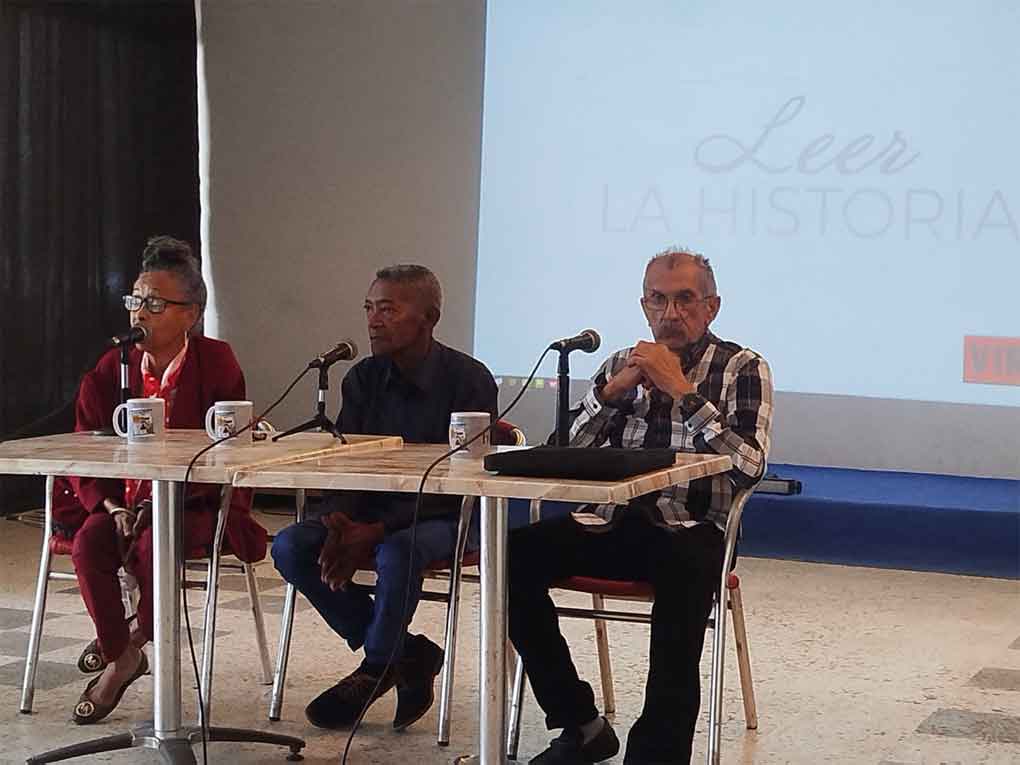
B The event highlighted Camaguey’s role as the birthplace of the Cuban Constitution. The panel, titled “Fidel Castro: A Life Dedicated to Humanity,” brought together academicians and prominent figures who, from diverse perspectives, analyzed the legacy of the Commander-in-Chief, with an approach that transcended national concerns to a universal dimension.
Maricela Valido, President of the Jose Marti Cultural Society, established an indissoluble link between the thought of Marti and Fidel.
“Marti teaches us from past glories for the present… and this is a premise for Fidel,” she stated, emphasizing his work as a “social educator” and his vision of history as the basis for the integral development of peoples.
For his part, MSc. Marcial Mendoza went over an intimate perspective, remembering Fidel Castro as “a man of exquisite human sensitivity.” “How could someone with so many responsibilities never lose touch with his family, his children, and his comrades?” he reflected, inviting the audience to explore this human side of the leader. The historical-political analysis was provided by Noel Manzanares, who traced Fidel’s relationship with Camaguey since 1953 and his early vision of socialism.
He cited his statement of January 4, 1959 – “Homeland is the place where the citizen is not exploited” – as a key reference point, emphasizing that his unified and Marti-inspired conception of the socialist project remained steadfast even after the fall of the European socialist bloc.
Fernando Manso, President of the Union of Historians of Cuba in Camaguey, emphasized at the closing ceremony the necessity of these spaces to discuss the thought and legacy of the Commander-in-Chief, which must endure in new generations, because Fidel Castro’s transcendence is based on the fusion of strategic thinking with global reach, an unwavering political will, and a profound human sensitivity—pillars that defined his leadership both inside and outside of Cuba.
jdt/rc/dfm