





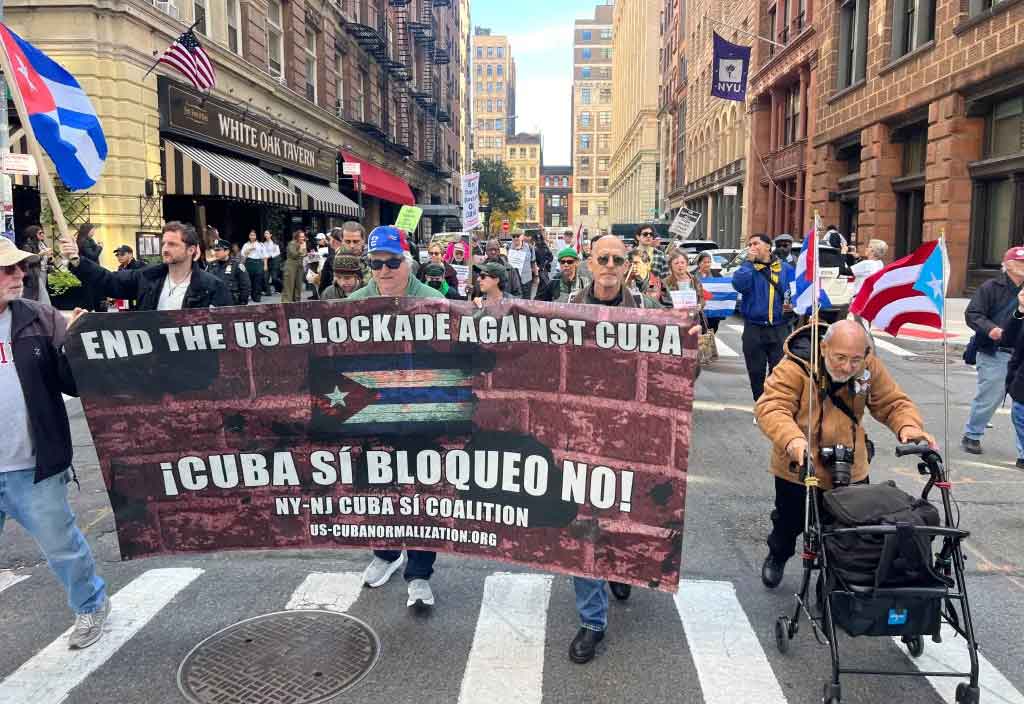
From October 24 to 31, the National Network on Cuba organized a “Global Week of Action against the US-imposed genocide in Cuba.”
Marches in New York City, along with interactive presentations at the Chicago Cultural Center (October 24), the First Baptist Church in Jamaica Plain, Massachusetts (October 26), and the Massachusetts Institute of Technology (MIT) in Boston (October 27), were among the actions taken in support of the Cuban people.
Meanwhile, in Miami, activist Pete Seidman reported that around 50 people protested against the blockade at the “Torch of Friendship” monument in the city’s downtown area.
The demonstration—held on October 28, the day the UN General Assembly voted on the Cuban resolution calling for an end to the blockade—highlighted that many people in Miami stand with the majority of the international community in supporting Cuba’s righteous demand.
Radio Miami also covered a demonstration at Federal Plaza in Chicago, where participants denounced the US government’s attempts to suffocate the Cuban people.
Additionally, labor unionists and political activists in the Los Angeles area—mobilized by Workers United, an organization affiliated with the Service Employees International Union (SEIU)—gathered to denounce the unilateral siege that has been imposed on the Cuban people for more than six and a half decades.
From that city in California, activist Mark Friedman commented on the turnout for the meeting.
“I want you to understand something with absolute clarity: the U.S. fuel blockade is not an abstract political debate,” stated Savannah Boyd, representing CodePink and All Power Books, which Havana refers as silent genocide.
jdt/rc/dfm