








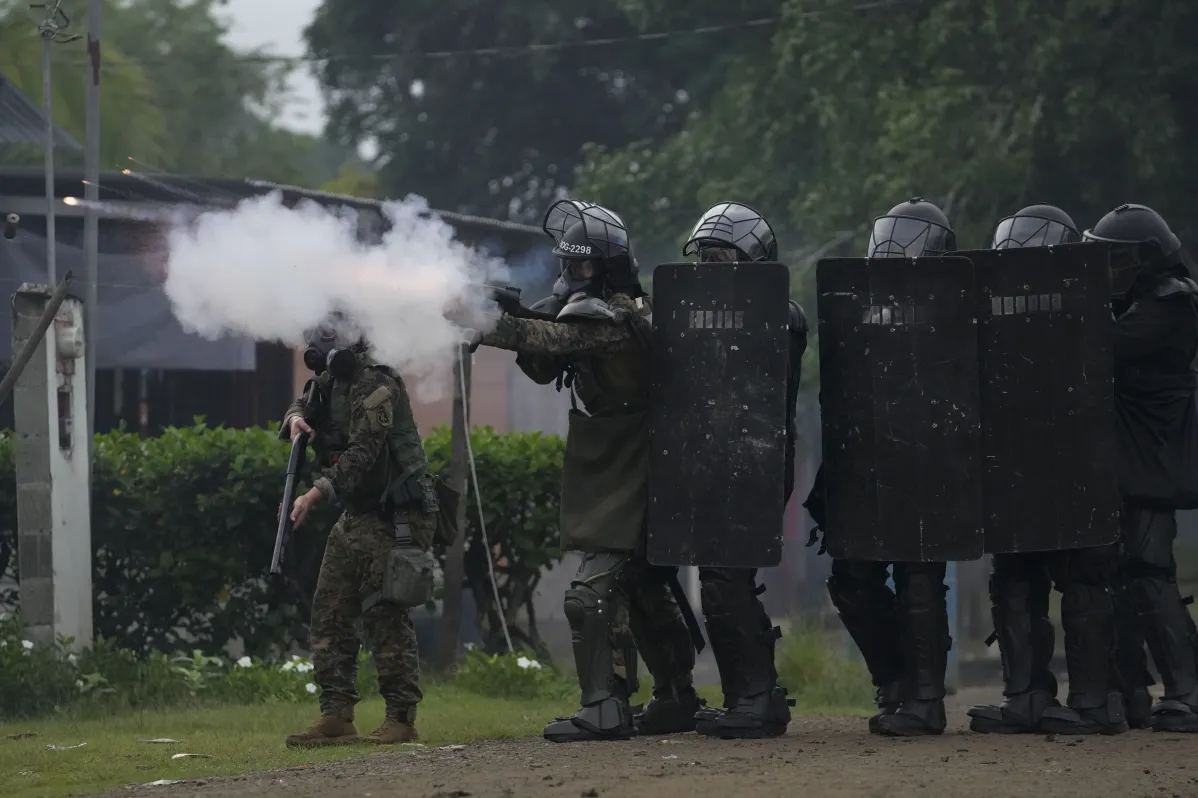
In marches along the main ways of the western territory – bordering Costa Rica-, residents remember that at that time, some 4,000 banana workers were wildly repressed by the army and the police while demonstrating against Law 30 (known as the Chorizo Bill), promoted by the government of Ricardo Martinelli (2009-2014).
At the time, Jose Raul Mulino – today’s Panamanian president – that was serving as Minister of Security, ordered similar actions, such as Operation Omega to clear blocked roads, and a state of emergency to quell protests against Law 462 of the Social Security Fund, also involving the excessive use of public force.
Many of the current protesters are close relatives of those who were killed 15 years ago during Mulino’s repression, and who is now confronting them with an even harsher hand, they noted.
On June 20, the Executive branch suspended for 10 days fundamental guarantees such as the rights of assembly, protest, freedom of movement, habeas corpus, inviolability of the home, and even religious freedom, as well as internet and mobile phone services, which was rejected by a large part of the population.
In practice, the head of state, his Minister of Security – Frank Abrego-, and his government, were also in a position to suspend the right to freedom of expression.
The director of the National Police, Jaime Fernandez, authorized arrests without a warrant or explanation, the suspension of habeas corpus (which they were later forced to reinstate); arbitrary searches, control of electronic devices, and censorship on social media, including social or religious gatherings.
Regarding this situation, members of the Popular Coordinating Commission for Human Rights of Panama and the Panamanian Observatory of Human Rights traveled to Bocas del Toro and met with relatives of the protesters and residents of indigenous communities affected by the violent incursion by law enforcement officers who fired tear gas, raided homes, and arbitrarily detained people.
jdt/mem/ga