








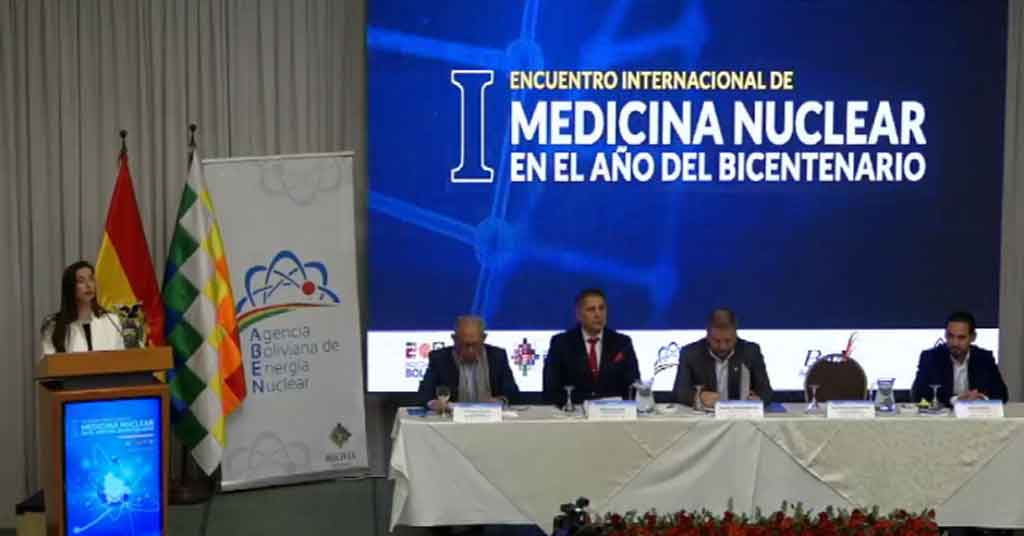
“Today we not only commemorate two centuries of struggle against colonialism and social inequalities, but we take a firm step towards a second and definitive independence: the scientific and technological liberation of our homeland (…)”, said the director of the Bolivian Nuclear Energy Agency (ABEN), Hortensia Jimenez at the inauguration of the event.
At the opening of the forum organized by ABEN and the Plurinational Public Management School (EGPP), Jimenez assured that this meeting is more than just an academic event is an act of social justice and a concrete achievement of the Democratic and Cultural Revolution that transformed Bolivia.
She added that it is an expression of the consolidation of science and quality health at the service of the people.
The head of ABEN noted that for centuries the most humble, indigenous and workers were excluded from advances in health, but today the Government, through ABEN, consolidated the Network of Nuclear Medicine and Radiotherapy Centers, equipped with state-of-the-art technology that is accessible to the whole population.
She said that “nuclear medicine is not a privilege but a right of the people and the fight against cancer and chronic diseases is not only a medical challenge, they are a political and social challenge”.
The director considered that the event marks a before and after in Bolivian health, not only to strengthen the capacities of professionals.
She stressed that it also paves the way for more precise and less invasive therapies, life-saving early diagnosis and radiopharmaceuticals produced with technological sovereignty.
“This meeting is not exclusive to experts, said Jiménez, it is a bridge for sharing knowledge between national and international scientists, because in Bolivia we believe that science must serve the people (…)”.
The director of ABEN appreciated the presence of the outstanding specialists participating, and said that their knowledge will enrich the dialogue for a more humane and accessible medicine.
abo/mem/jpm