








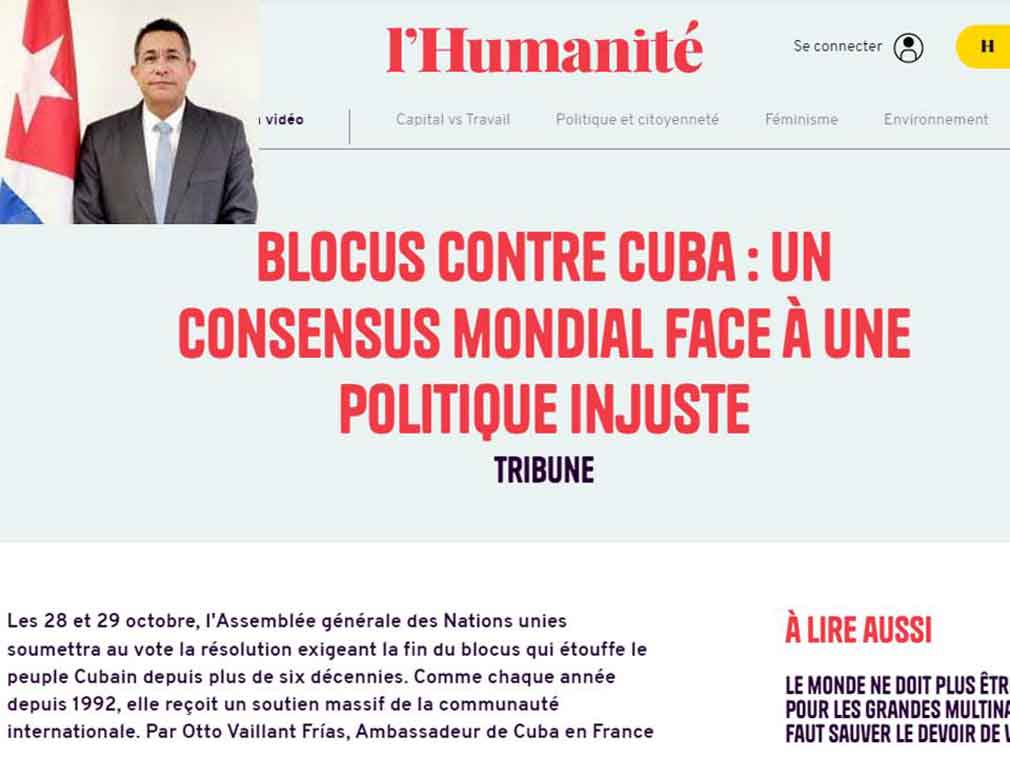
In a column in the French newspaper L’Humanite, the diplomat recalled that on October 28 and 29, the United Nations General Assembly will consider the resolution “Necessity of ending the economic, commercial, and financial blockade imposed by the United States against Cuba,” a text similar to the one that has received overwhelming support from the international community year after year since 1992.
Although it has been defended by the United States as a tool of political pressure, in practice, the blockade in place for more than six decades has proven to harm the population, limit national development, and provoke almost unanimous condemnation in international forums, he added.
Vaillant noted that over the years, Washington has strengthened its blockade and its extraterritorial reach through laws such as the Torricelli Act (1992) and the Helms-Burton Act (1996), in a hostile response to the independent and sovereign path taken by the island with the January 1, 1959, Revolution.
Currently, Cuba faces severe obstacles in acquiring capital goods, medical supplies, technology, fuel, and agricultural products, which directly impacts vital sectors such as health, food, energy, and technological development, he emphasized.
According to the Cuban ambassador, the blockade, implemented and intensified by successive US administrations, also severely restricts the financial sector, with many banking institutions refusing to operate with the Caribbean country for fear of sanctions.
Added to all this are the disinformation and manipulation campaigns on digital platforms aimed at undermining internal stability and discrediting the Cuban government, he wrote in L’Humanite.
jdt/ro/wmr