








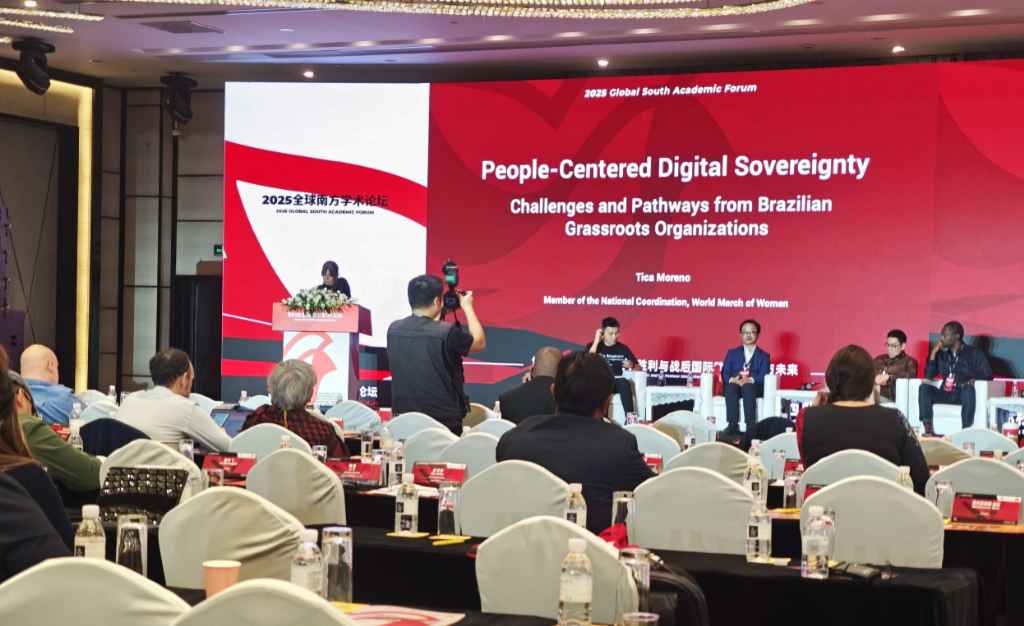
During his address, South African academic Busani Ngcaweni stated that new technologies should foster a more balanced communications order, while Professor Lu Xinyu, president of the Forum, noted that this event seeks to strengthen international academic cooperation.
On this second day, some 200 participants from 29 countries also examined the challenges of digital sovereignty and the peaceful use of artificial intelligence (AI) in the Global South.
Experts pointed out that open-source models allow for the development of sovereign AI.
The panel brought together specialists from China, the Democratic Republic of Congo, Malaysia, Russia, and Brazil.
The second session analyzed the need to break Western hegemony in the global flow of information.
In this section, Randy Alonso Falcon, Director General of Ideas Multimedios in Cuba, emphasized the importance of confronting together the media war waged by the collective West and defending the commitment to “a different world, one of peace and dialogue, against fascism and xenophobia.”
During the event, participants also discussed rural experiences in Brazil and China, comparing the struggles for land in the South American giant with agrarian reform and rural revitalization in the Asian country.
jdt/jav/otf/idm