






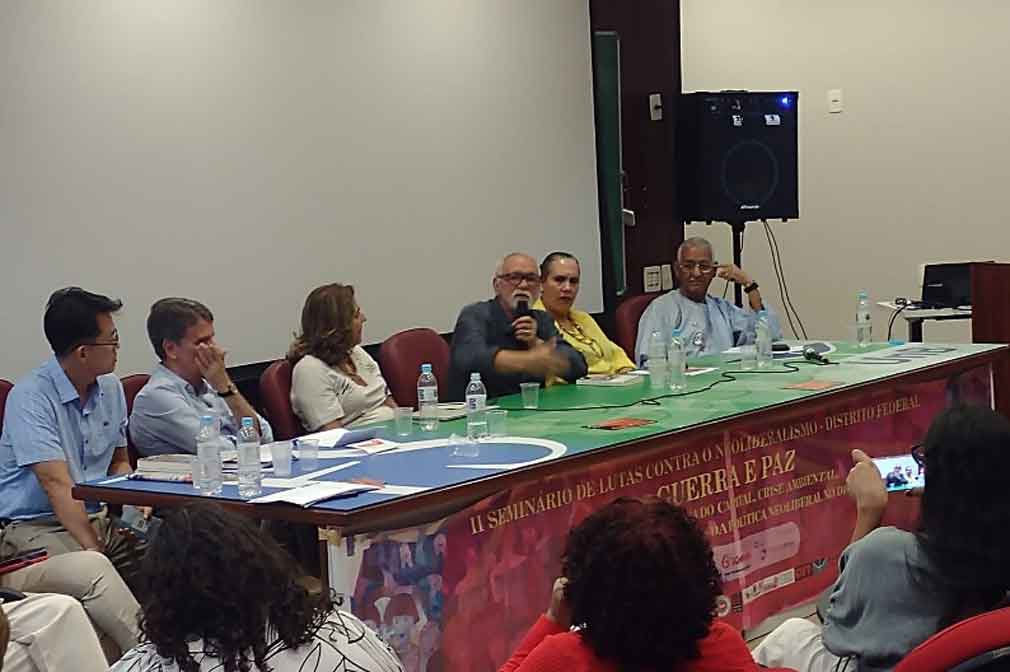
Held at the Darcy Ribeiro School of Health Sciences, the meeting brought together researchers, professors, students, and social activists who dissected the roots of the capitalist crisis and its many facets: inequality, wars, environmental collapse, and technological manipulation.
Brazilian PhD. Aluisio Pampolha, a leading figure in geopolitical thought from a historical materialist perspective, emphasized that the forum condemned not only the blockade of Cuba, but also the aggressions in Gaza, the war in Ukraine, and the imperial maneuvers against Venezuela and North Korea.
From a Latin American and Marxist perspective, the specialists agreed that the “organic crisis of capital” is currently a structural disease that threatens global stability, while financial elites expand job insecurity, rentierism, and inequality.
Idalmis Brook, a counselor at the Cuban Embassy in Brazil, with a master’s degree in International Relations, summarized the challenges of the present: armed conflicts, polarization, climate collapse, and a growing social divide.
She alluded to social and media manipulation as a new instrument of global domination and warned of the interconnectedness between technological risks, the geopolitics of war, and the environmental crisis.
She also rememeberedd the visionary thinking of Fidel Castro, the historic leader of the Cuban Revolution, whose centenary will be celebrated in 2026, and cited his warning: “Bombs may kill the hungry, but not hunger or the just rebellion of the people.”
jdt/ro/ocs