








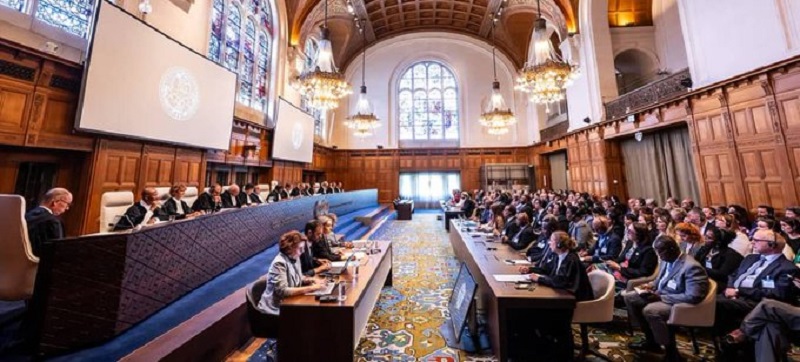
The Minister affirmed that the ICJ’s verdict enshrines the obligation of all States to fulfill their commitments to prevent and address climate change, as well as the international responsibility they incur if they fail to do so.
Rodriguez reaffirmed that his country will continue to promote, with the highest priority, policies and actions to address sustainability, protection, and respect for the environment.
According to the Cuban Foreign Minister, it is not possible to face the challenges posed by the problem “without the cooperation, priority, and participation of all nations, taking into account their common but differentiated responsibilities, and according to their respective capabilities and social and economic situation.”
The advisory opinion, read by ICJ President Yuji Iwasawa in a public session, pointed out that key climate treaties, including the UN Framework Convention on Climate Change, the Kyoto Protocol, and the Paris Agreement, impose “binding obligations” on the States Parties.
These obligations include taking measures to mitigate greenhouse gas emissions, adapting to climate change, cooperating according to the principle of common but differentiated responsibilities and respective capabilities, and fulfilling commitments regarding finance and technology transfer.
jdt/mem/lld